About the Breed
Overview
History
Breed Standard & Structure
Breeding Dutch Shepherds
Competition
Coat Types
Temperament
Training & Care
Puppy Buyer Guide
On this Page
What the Standard Tells Us
General Appearance
Size & Proportion
Head & Expression
Body & Build
Coat & Color
Movement
Temperament as Part of the Standard
Disqualifications
A Note on Standards
Breed Standard & Structure
What the Standard Tells Us
A breed standard is more than a physical description — it's a blueprint for a working dog built to last. For the Dutch Shepherd, the standard reflects a dog shaped by centuries of practical use, and every element of structure, proportion, and movement connects back to that working heritage. Nothing is exaggerated. Nothing is ornamental. Everything serves a purpose.
This page draws from the FCI standard (the international authority for the breed) and the AKC/UKC standards used in the United States. Where they differ in detail, both are noted.
“This description is provided for general informational and educational purposes. It is not a replacement for official standards published by kennel clubs or governing breed organizations.→ FCI Dutch Shepherd Standard | → AKC Standard | → UKC Standard”
General Appearance
The first impression of the Dutch Shepherd is of a medium-sized, middle-weighted, well-muscled dog of powerful and well-balanced structure. The carriage is natural and relaxed, but alert — a dog with lots of endurance, a lively temperament, and an intelligent expression. Dutchshepherd
The body is slightly longer than tall, with the length of the body from point of shoulder to point of buttock exceeding the height at the withers at approximately a ratio of 10:9, as suits a trotting dog. Dogsglobal This rectangular outline is not a flaw — it is precisely what allows the breed to move with efficiency and endurance over long distances.
The breed is presented in three coat varieties — short, long, and rough — and the difference between sexes should be clearly recognizable, particularly in the shape of the head and build of body.
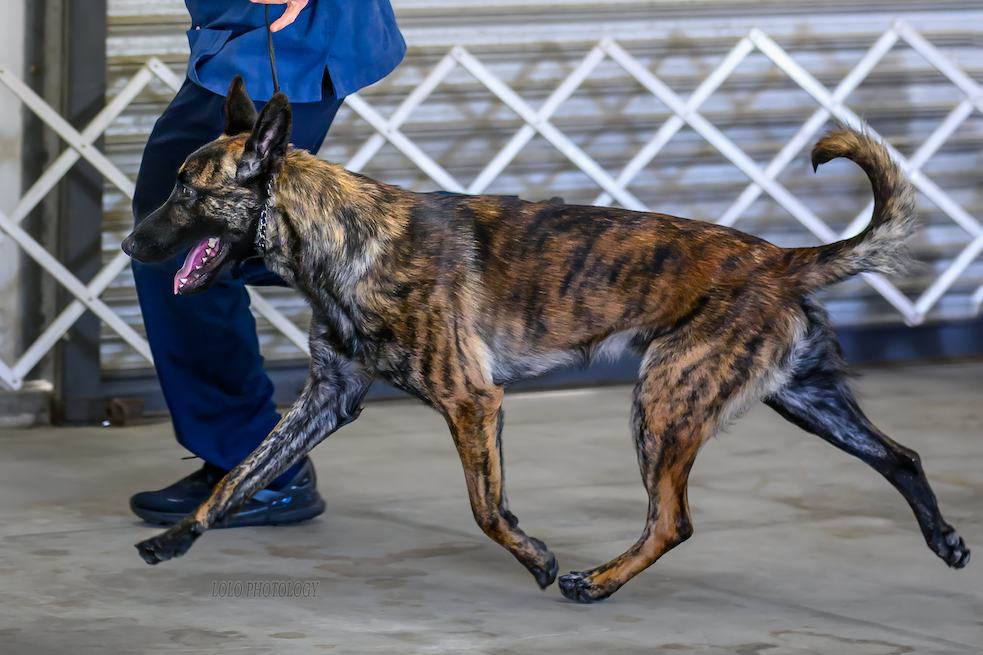
Tiger Opal Breeder Sylviane Chapoulaud (used with Permission)
Size & Proportion
Males should be 22½ to 24½ inches in height and females 21½ to 23½ inches, measured at the withers. Dutchshepherd The FCI standard is consistent with this, specifying males at 57–62 cm and females at 55–60 cm. Fédération Cynologique Internationale Weight is always in proportion to height, with the accepted range typically falling between 50–70 lbs (23–32 kg). Faults in size or proportion are assessed not simply by deviation from the numbers, but by the degree to which that deviation would affect the dog's working ability and welfare.
Head & Expression
The head is clean-cut and well-proportioned to the body. The skull is moderately broad and flat, with a muzzle that is strong and straight. The proportion of the length of the skull to the muzzle is 1:1. Dogsglobal The stop is visible but not abrupt, and the nose is always black. The eyes are medium-sized, almond-shaped, and dark in color, set slightly obliquely and giving a sharp, alert expression. They should never appear round, protruding, or light in color. The ears are medium-sized, triangular, firm, and carried erect — set high on the head and pointing forward when the dog is alert. The overall expression is lively, intelligent, and attentive. It should immediately communicate a dog that is present, capable, and ready to work.
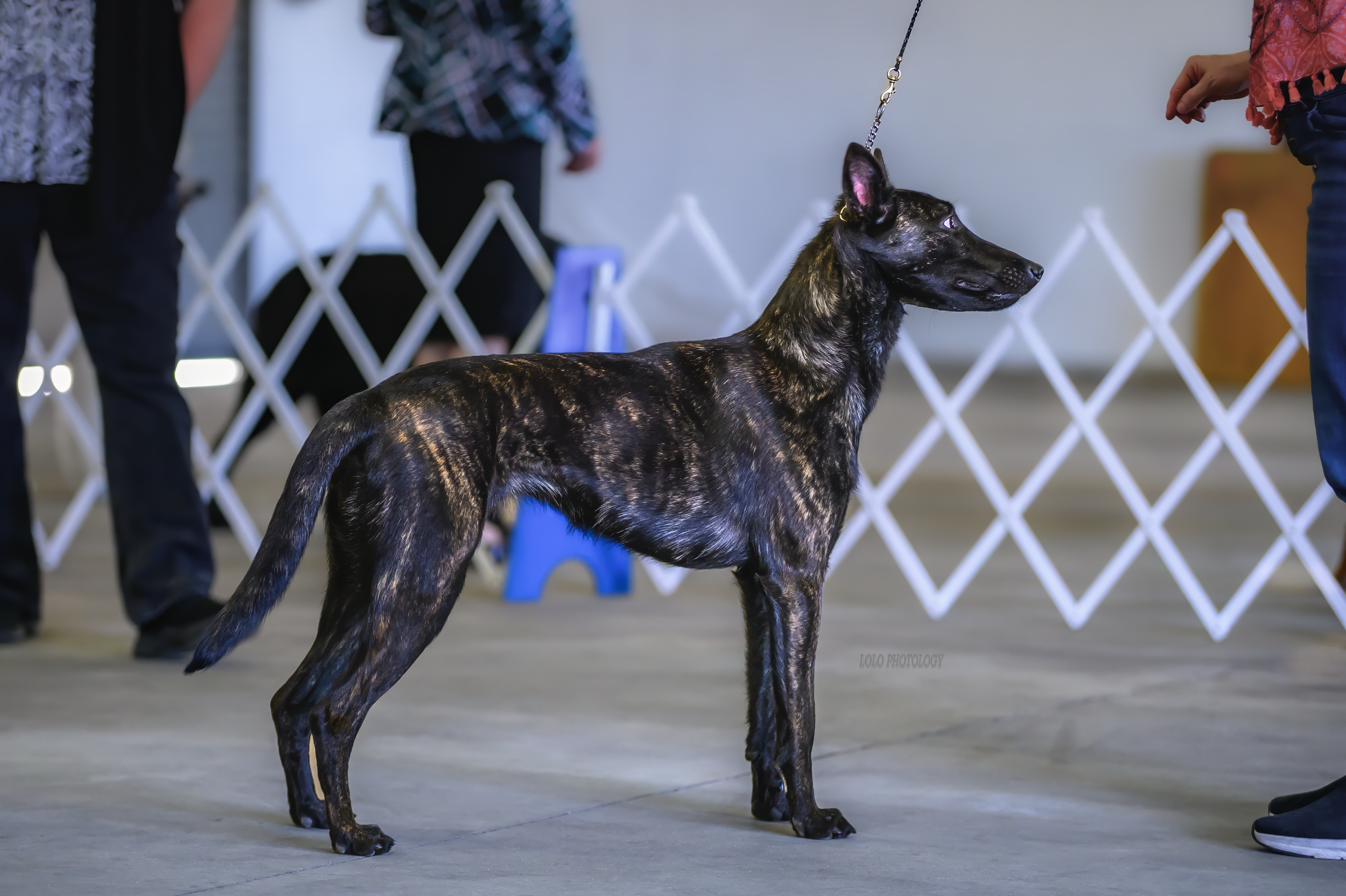
Coco / Owner Sylviane Chapoulaud (used with Permission)
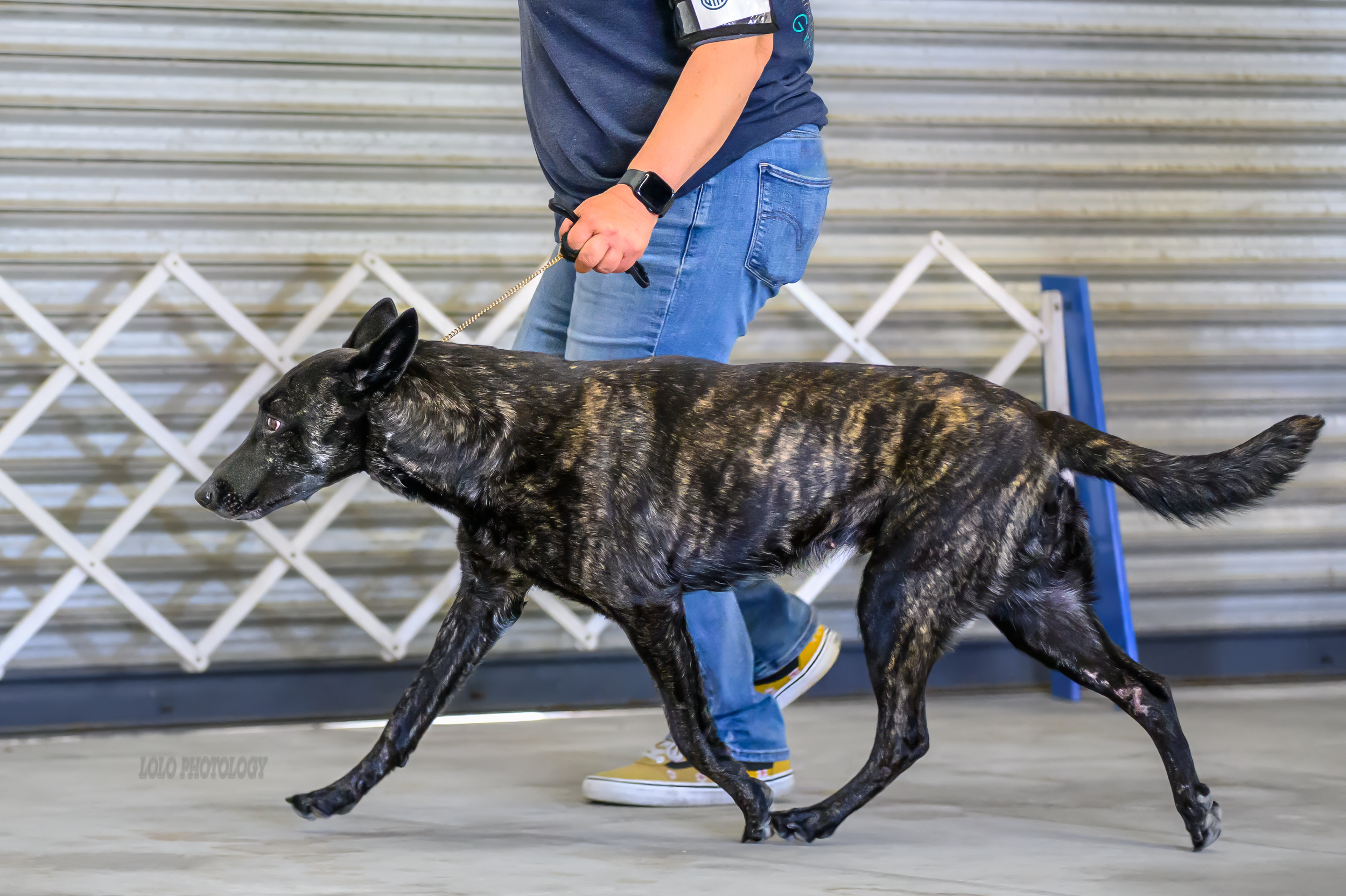
Fifille / owner Sylviane Chapoulaud (used with Permission)
Body & Build
The neck is strong, muscular, and of moderate length, flowing smoothly into the shoulders with no loose skin or throatiness. The topline is straight and firm. The chest is deep and well-developed, with ribs that are well-sprung but not barrel-shaped. The abdomen is slightly tucked up, reinforcing the athletic outline.
The forelegs are straight and strong with solid bone — without heaviness. The hindquarters are powerful and well-muscled, providing the drive that characterizes the breed's movement. Feet are oval to round, compact, with well-arched toes and firm pads.
The tail is long and natural, reaching at least to the hock when at rest. In movement it may rise slightly, but it must never curl over the back. It completes the dog's balanced, unexaggerated outline.
Coat & Color
The Dutch Shepherd comes in three coat varieties, all weather-resistant and practical for working conditions:
Short coat — all over the body, quite hard and close-fitting, with a woolly undercoat. Ruff, breeches, and tail plume are clearly visible.
Long coat — all over the body, long, straight, and harsh to the touch, without curls or waves, with a woolly undercoat. Distinct ruff and breeches, with the tail abundantly coated.
Rough coat — dense, harsh, and tousled with a woolly undercoat all over the body except the head. The upper and lower lip are well-covered with hair, with distinct whiskers, beard, and coarse rough eyebrows.
The only accepted color is brindle — gold brindle or silver brindle — with brindling clearly visible over the entire body and a typically dark mask. White markings are minimal and limited. Solid black body patches are a disqualification.
Movement
The Dutch Shepherd is a trotter with free, smooth, and supple movement, without exaggerated drive or stride. Dogsglobal The legs are not brought forward in a tied way — neither floating nor far-reaching. United Kennel Club At a fast gait the breed tends to single-track, with legs converging toward the center line of gravity. The backline remains firm and level throughout, with no crabbing. Movement should reflect stamina, balance, and efficiency. It is not meant to impress — it is meant to sustain.
Temperament as Part of the Standard
The breed standard does not treat temperament as separate from structure — it is considered integral to what the Dutch Shepherd is. The Dutch Shepherd should reflect the qualities of loyalty and reliability, alertness and watchfulness. He is active and independent, with persistence and intelligence, prepared to be obedient, and gifted with the true shepherding temperament. Dutchshepherd Aggression without cause and excessive shyness are both disqualifying faults. A Dutch Shepherd that cannot be approached, handled, and trusted in a working context is not meeting the standard — regardless of how correct its structure may be.
Disqualifications
The following are disqualifying faults under the recognized standards:
Unilateral or bilateral cryptorchidism
Viciousness or extreme shyness
Solid black body patches
Albinism
Any dog clearly showing physical or behavioral abnormalities
A Note on Standards
The FCI standard is the international reference for the Dutch Shepherd and the authority in the breed's country of origin. The UKC and AKC standards used in the United States are closely aligned with the FCI but contain some variation in language and emphasis. For anyone involved in showing, breeding, or evaluating Dutch Shepherds, consulting the official published standards directly is always recommended.
FCI Dutch Shepherd Standard | AKC Standard | UKC Standard