History
A Dog Shaped by Work
The Dutch Shepherd was never designed. It was forged — by the demands of Dutch farm life, by harsh weather, by long days and harder work. Long before any breed club existed or any standard was written, this dog was already doing its job across the fields and homesteads of the Netherlands. Its history is not a story of careful curation or fashionable breeding. It's a story of survival, purpose, and an extraordinary dog that refused to become irrelevant.
Built for the Farm
The Dutch Shepherd is one of the Netherlands' oldest working farm dogs, developed during the 19th century when Dutch farmers needed a versatile, intelligent, and tireless helper. In a landscape dominated by sheep farming and small, multifunctional homesteads, the dog had to do far more than herd. It guarded property, accompanied farmers to market, pulled small carts, and kept livestock away from crops. Because Dutch farmers valued practicality over appearance, the dogs were selected for ability, sound structure, and weather-resistant coats rather than for a standardized look.
This is what historians of the breed call a landrace dog — not a breed created to fit someone's ideal, but one that simply developed, shaped entirely by the work it was asked to do.

Permission from Elizabeth Brennan
Becoming a Breed
By the late 19th century, the Dutch Shepherd had become distinct enough from its shepherd cousins that enthusiasts felt it deserved formal recognition. In 1898, the Nederlandse Herdershonden Club (NHC) was founded and the first official breed standard was written — cementing the Dutch Shepherd as a breed in its own right.
In those early years the lines between Dutch, Belgian, and German Shepherds were still blurry. Dogs were sometimes crossed, and it was still possible to enter the same dog in a show under either name. The 1898 standard began drawing the distinction. Then in 1914, the standard was revised to establish brindle as the only accepted coat color — a deliberate move that gave the Dutch Shepherd its defining visual identity and formally separated it from its cousins for good. That decision still defines the breed today.
Decline, Near Loss & Revival
As industrialization spread and traditional farm life changed, the Dutch Shepherd's original role began to fade. By the early 20th century, the population of working farm dogs declined dramatically. Both World Wars compounded the damage — dogs were lost to wartime use, starvation, and necessity, and breeding programs halted almost entirely. By the 1950s, estimates suggest fewer than a hundred purebred individuals remained in the Netherlands.
Fortunately, a small number of dedicated breeders and Dutch dog clubs preserved the breed by documenting its characteristics and promoting its working ability. Through the 1960s they scoured rural areas to locate surviving dogs and rebuild the population — prioritizing working traits above all else. On 1 February 1971, the Dutch studbooks were formally closed, drawing a firm boundary around what the Dutch Shepherd was and protecting what had been so carefully restored.
A New Purpose
In the decades that followed, the Dutch Shepherd found a new purpose. Police departments and military organizations discovered that the breed's intelligence, trainability, and natural athleticism made it an exceptional service and protection dog. The KNPV — the Royal Dutch Police Dog Association, founded as early as 1907 — had long recognized this potential, and Dutch Shepherds began earning elite titles that made them sought-after worldwide for police and military work.
Today, Dutch Shepherds continue to thrive in roles such as search and rescue, detection work, and competitive dog sports, while still maintaining the adaptable, all-purpose farm-dog character that defined their ancestors.
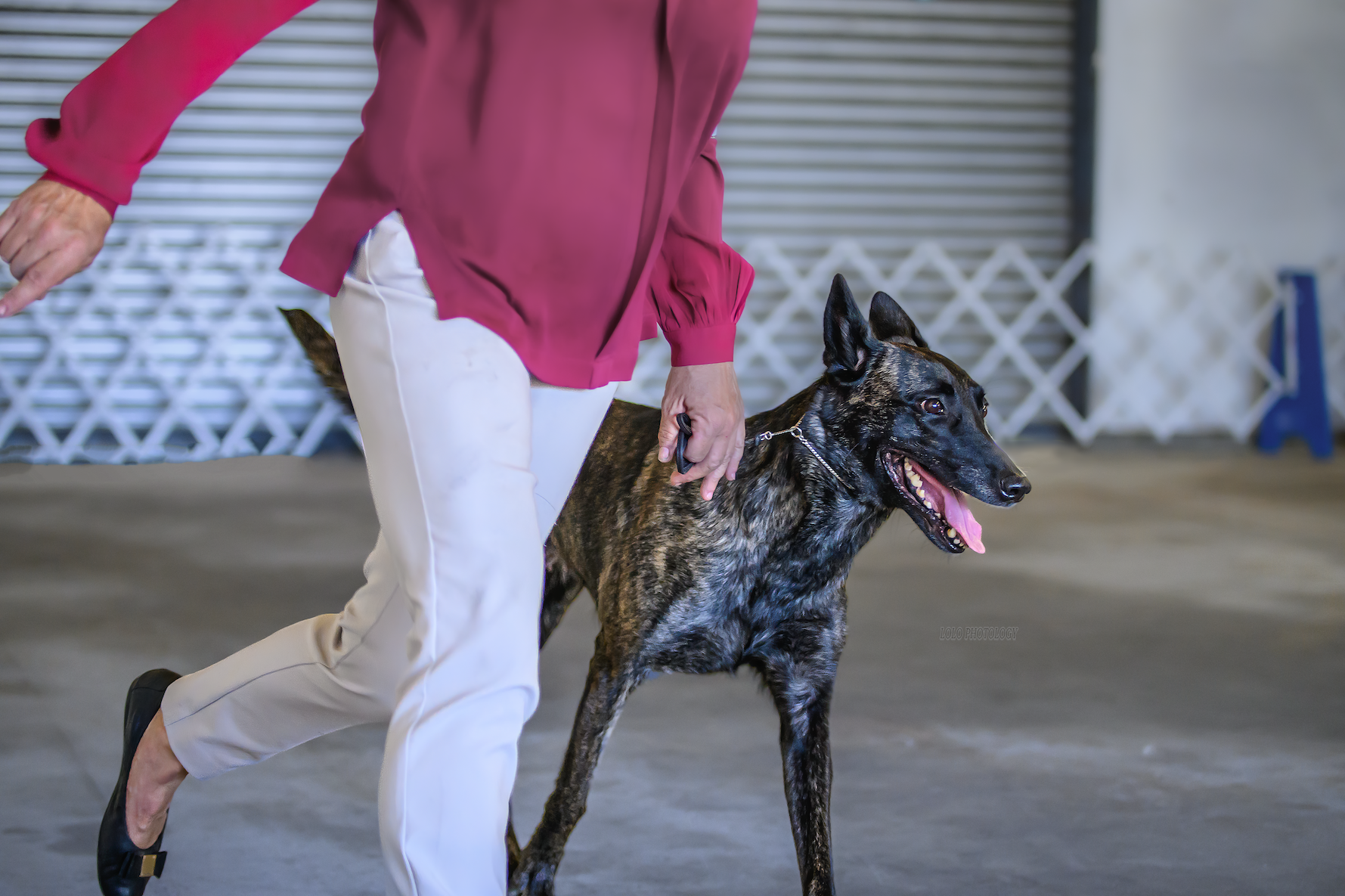
Ivy with owner Sylviane Chapoulaud (used with Permission)
Recognition Timeline
1898
NHC founded; first breed standard written
1907
KNPV (Royal Dutch Police Dog Association) founded
1914
Brindle established as the only accepted coat color
1954
FCI provisional recognition
1955
FCI definitive recognition (5 November)
1971
Dutch studbooks closed (1 February)
1995
UKC recognition in the United States
2012
AKC Foundation Stock Service (FSS)
2017
AKC Miscellaneous Class (effective 1 January)
“A note on AKC status: The Dutch Shepherd is currently in the AKC Miscellaneous Class and has not yet achieved full AKC breed recognition. Dogs recorded under the FSS are eligible to compete in AKC companion events but are not eligible for regular AKC registration.”
The Dutch Shepherd Today
More than 125 years after that first standard was written, the Dutch Shepherd remains remarkably true to what it always was — versatile, intelligent, tireless, and loyal. Still relatively rare compared to its Belgian and German cousins, it is deeply respected among those who know it, and increasingly sought out by people who want a dog with genuine working heritage.
Its community spans herding traditionalists, KNPV and IGP competitors, show enthusiasts, working dog professionals, and devoted family owners. What unites them is an appreciation for a dog that was never bred for fashion — only for excellence.
That legacy is still being earned, every day.